Leave Your Message
Choosing the right Ev Cable is more than matching a plug to a vehicle. Global buyers must assess charging speed, electrical safety, climate exposure, and long-term durability. A cable used in a cold Canadian driveway may perform differently in a humid coastal warehouse.
Small details matter. Check the connector type, current rating, voltage range, and cable length before ordering. A 7-meter cable can reach a distant wall box, but it may be heavier to store. A shorter model reduces clutter, yet it can limit parking flexibility. Practical experience often reveals this trade-off.
Safety comes first. Confirm that the cable includes suitable insulation, strain relief, and protection against heat, water, and abrasion. Ask suppliers for test reports, quality records, and traceable production information. Regional certification requirements may also differ, so buyers should verify current rules with qualified local professionals.
Do not trust attractive specifications alone.
A reliable manufacturer should explain testing conditions clearly. It should also provide consistent technical documents, warranty terms, and responsive after-sales support. Some buyers focus heavily on charging speed and overlook connector wear. Others choose the lowest price, then face replacement costs after repeated outdoor use.
These seven tips offer a practical framework for comparing options. They are not a substitute for engineering review. Even experienced buyers can miss a compatibility detail when products cross markets. Careful questions, realistic usage scenarios, and documented evidence can make the final Ev Cable selection safer, more efficient, and easier to maintain.
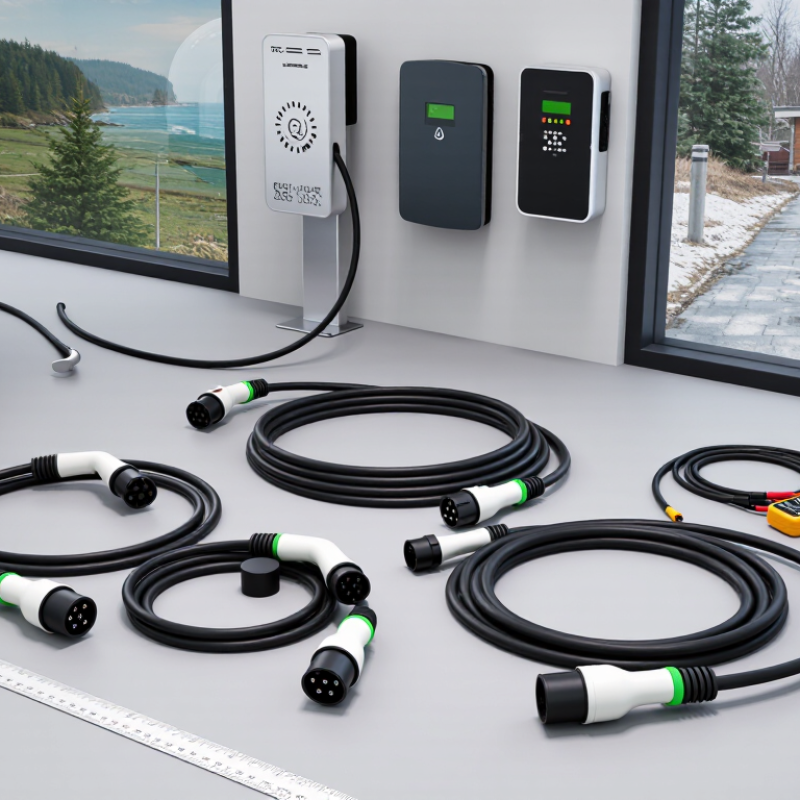
Choosing an EV cable starts with the vehicle, charger, and electrical supply. A 22 kW AC charger usually operates at 400 volts, three-phase, requiring about 32 amps per phase. On single-phase power, the same output needs nearly 92 amps. Check this detail carefully. It changes cable size, connector temperature, and installation cost.
A 350 kW DC charger demands a different calculation. At 800 volts, the current is about 438 amps. At 400 volts, it approaches 875 amps. Cable length, ambient heat, installation method, and charging duration can raise the required rating. Liquid-cooled cables may suit repeated high-power sessions, while air-cooled options can be simpler for shorter duty cycles. IEC 61851 and IEC 62196 provide useful technical references for charging control and connector design, but local electrical requirements still matter.
Demand is growing quickly. The International Energy Agency’s Global EV Outlook 2024 reports more than four million public charging points worldwide at the end of 2023. It also records strong growth in fast-charging infrastructure. That growth does not make every 350 kW cable suitable. A practical buyer should request continuous-current ratings, temperature limits, voltage class, bending radius, and test documentation. The easy mistake is comparing peak kilowatts only. Real installations are rarely perfect. A small voltage drop, undersized conductor, or overheated connector can reduce charging speed. Recheck the numbers before ordering.
| Tip | Charging Requirement | Electrical Reference | Recommended Cable Considerations | Typical Use Case | Key Buyer Check |
|---|---|---|---|---|---|
| 1 | Define the target power Select the required AC or DC charging level before choosing a cable. | AC charging transfers power through the vehicle's onboard charger. DC fast charging supplies direct current through off-board power equipment. | Confirm that the cable's rated voltage, current, and power are equal to or higher than the planned charging system. | Home, workplace, destination, fleet, and public fast-charging installations. | Match the cable to both the charging equipment output and the vehicle inlet limit. |
| 2 | AC charging up to 22 kW Three-phase AC charging is commonly specified at approximately 22 kW. | At approximately 400 V three-phase, current is about 32 A per phase: P ≈ √3 × V × I ≈ 22 kW. | Use a three-phase cable rated for at least 32 A and the applicable AC voltage. A cable with a higher current rating may be selected for future flexibility, subject to equipment limits. | Residential, commercial, and destination charging where three-phase supply is available. | Verify phase count, local grid voltage, connector configuration, cable length, and installation regulations. |
| 3 | DC charging up to 350 kW High-power DC charging requires substantially higher current than AC charging. | At 800 V DC, 350 kW requires approximately 438 A. At 400 V DC, the theoretical current is approximately 875 A. | Select a high-current DC cable and connector assembly specifically engineered for the intended voltage, current, thermal load, and cooling method. | Highway charging, commercial fleets, logistics depots, and high-utilization charging sites. | Do not assume that a 350 kW station delivers 350 kW to every vehicle; vehicle voltage, battery temperature, state of charge, and charging limits affect actual power. |
| 4 | Check current and thermal management Cable current capacity depends on installation conditions and heat dissipation. | Higher current creates greater heat generation. Continuous current ratings must account for ambient temperature, duty cycle, bundling, and contact resistance. | For very high DC current, evaluate liquid-cooled cable options, temperature sensing, flexible construction, and protection against overheating. | Repeated charging sessions, hot climates, enclosed spaces, and high-throughput fleet operations. | Request the continuous current rating, cooling requirements, temperature range, and derating curve. |
| 5 | Choose the correct connector system Connector compatibility is essential for safe electrical and mechanical connection. | AC and DC charging use different connector arrangements in different markets. Regional vehicle inlets and charging infrastructure must be matched. | Confirm connector type, pin configuration, locking method, communication compatibility, ingress protection, and cable-side termination. | Cross-border vehicle fleets, export projects, and charging networks serving multiple vehicle types. | Check the target market's applicable standards and ensure the connector is approved for the intended charging mode. |
| 6 | Balance length, flexibility, and voltage drop A longer cable improves reach but can increase weight, voltage drop, and handling difficulty. | Cable resistance increases with conductor length. Voltage drop and heat must remain within the limits specified by the system designer and applicable standards. | Select the shortest practical length, adequate conductor size, suitable bend radius, abrasion resistance, and ergonomic grip design. | Wall-mounted chargers, pedestal chargers, parking bays, bus depots, and constrained charging spaces. | Consider parking layout, connector storage, bend radius, cable weight, and expected user handling frequency. |
| 7 | Verify safety, environment, and compliance The cable must remain reliable throughout its expected operating conditions. | Important factors include insulation performance, protective earthing, temperature rating, mechanical durability, water and dust resistance, and electrical protection. | Ask for applicable test reports, certification evidence, ingress protection rating, flame behavior information, operating temperature range, and service-life data. | Outdoor charging, winter climates, coastal areas, industrial sites, and public-access installations. | Confirm compliance with the destination market's electrical, safety, EMC, and charging-equipment requirements before purchase. |
| Important calculation note: Actual charging power is limited by the lowest-rated component in the system, including the grid supply, charger, cable, connector, vehicle inlet, battery, and charging software. Approximate current values are calculated using P = V × I for DC and P = √3 × V × I for balanced three-phase AC; real-world values may vary because of power factor, conversion losses, temperature, and derating. | |||||